The Blog

Posted in Content Creation

3 Things I Learned from My Social Media Detox

It’s Okay to Take a Break

Social media has evolved from mindless fun to be a huge part of our daily lives. It’s how we consume most of our information, and it influences everything from elections to public discourse. 

But social media is not real life. As much influence, or seeming influence, it has, it’s a curated and selective sample of what’s actually going on in the world.

Social media is addictive. It is designed to keep you coming back with notifications and likes. It’s keeps you on a constant loop seeking gratification. Every time there is a new notification or Like, you get a little bit of a dopamine hit. This is most definitely done on purpose.

These apps and websites have been optimized by behavioral scientists and psychologists to keep you engaged for as long as possible. The more you visit the app or website, and the longer you stay on the platform, the more ads they can present you. The more ads you see, the more money they can make off of you.

You begin to find validation and satisfaction with the interactions on their platform. You fiend for it like a drug.

If you feel like social media has taken over your life, if it is constantly on your mind, or if you find yourself always reaching for your phone, mindlessly scrolling to fill the “boredom,” these might be signs that you need a break.

1. There is so much time in the day to get things done, afterall.

It is amazing how much free time you have when you stay away from social media. Time that can be spent on the things you actually care about, or changes you can make to improve your world. You get a chance to take a step back and evaluate what’s truly important in your life and what is a more worthy use of your time and mental energy.

When you start a social media detox, you will probably be a little “bored.” That compulsion to check your notifications whenever your phone is in your hand has to be replaced with something. The amount of time you spend on your phone will have to be used for something else. Hopefully, something much more productive.

2. You don’t really need it to stay “informed” or “connected” to people.

For some, social media is how they stay informed. For others, it’s how they keep in touch with friends they aren’t able to see everyday in real life.

If they were to take a social media break, they would feel like they are missing out. But it is not true. If something is that important, you’ll hear about it from a friend, family member, or colleague. And, you can still watch the news on tv. Besides, most of the information being consumed is only a distraction and not actual news.

If you follow inspirational people on social media, you can still read books, watch documentaries, or listen to podcasts for a while to fill that void.

To stay in touch with people, you can call, text, email, or even VISIT them IRL! You’ll realize how few people you actually want to check in on regularly. You won’t know what Cindy from the third grade had dinner, but you will know how Grandma is doing or how your nephew did in his baseball game.

3. Disconnecting is good for your mental health.

Social media is not real life. It sucks you into a curated world full of pretty people doing extraordinary things, living in beautiful houses, driving luxury cars, and buying expensive toys. It can make you feel bad about yourself and your life.

This is toxic to our mental health. And, most of it is useless to you besides disturbing your inner peace.

After a week or so, you will start to feel less need to keep up with the Jones’s, whom you’ve never even met. You’ll inevitably compare yourself less to other people. This will lower your anxiety because you won’t feel the stress to keep up with the imaginary lives of the Insta-perfect.

If possible, replace your social media habit with something else.  

Some suggestions:

  • Reading all those books you’ve been meaning to read
  • Spending time with friends and family
  • Taking up a new hobby
  • Learning a new skill
  • Exercising
Posted in Affirmations

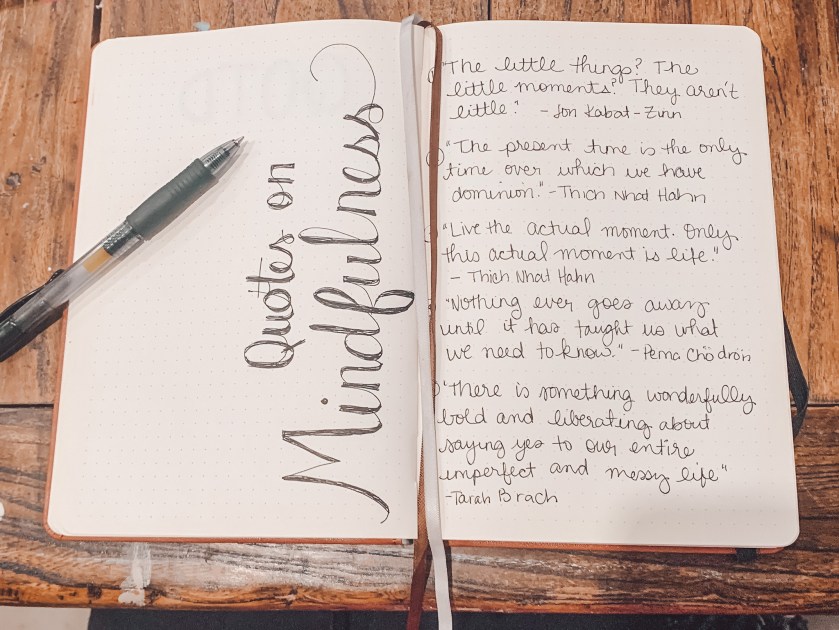
21 Quotes on Mindfulness

Mindfulness is the awareness of everything that is going around you and within you. In this post, I’ve collected 21 quotes about mindful thought and the practice of mindfulness.

These are my submission to my hashtag #apainterly21 January Theme: Mindfulness.

1.

With our thoughts we make the world.

Buddha

2.

Life is a dance. Mindfulness is witnessing that dance.

Amit Ray

3.

The little things? The little moments? They aren’t little.

Jon Kabat-Zinn

4.

The present moment is the only time over which we have dominion.

Thích Nhất Hạnh

5.

Do every act of your life as though it were the very last act of your life.”

Marcus Aurelius

6.

Live the actual moment. Only this actual moment is life.

Thích Nhất Hạnh

7.

Nothing ever goes away until it has taught us what we need to know.

Pema Chödrön

8.

There is something wonderfully bold and liberating about saying yes to our entire imperfect and messy life.

Tara Brach

9.

Looking at beauty in the world, is the first step of purifying the mind.

Amit Ray

10.

Peace comes from within. Do not seek it without.

Buddha

11.

Nothing can harm you as much as your own thoughts unguarded.

Buddha

12.

Paradise is not a place; it’s a state of consciousness.” 

Sri Chinmoy

13.

Nature does not hurry, yet everything is accomplished.

Lao Tzu

14.

Slow down, you’ll get there faster.

Katherine King

15.

When we allow ourselves to embrace the moment, we allow ourselves to live.

Lisa Bien

16.

The little things? The little moments? They aren’t little.

Jon Kabat-Zinn

17.

Happiness is your nature. It is not wrong to desire it. What is wrong is seeking it outside when it is inside.

Ramana Maharshi

18.

Mindfulness is a way of befriending ourselves and our experience.

Jon Kabat-Zinn

19.

Life is not lost by dying; life is lost minute by minute, day by dragging day, in all the small uncaring ways.

Stephen Vincent Benet

20.

If you want to conquer the anxiety of life, live in the moment, live in the breath.

Amit Ray

21.

Smile, breathe, and go slowly.

Thich Nhat Hanh

Posted in Lifestyle

Eight Ways to Think Outside the Box

Everyone always talks about “thinking outside the box.” This simply means that you need to come up with a brand new way to tackle an issue or problem in order to find solutions that the old ways of doing things may not.

Sometimes, though, it’s hard to get over thinking about things the same way. You may need to employ some tactics and techniques to break out of the mold and think outside the box.

  1. Get a Second Opinion – When you’re stuck and cannot come up with any new ideas, you can boost your creativity simply by getting another opinion. Even if the opinion is contrary to yours or out and out wrong, it will stimulate a new part of your brain learning about it, thus triggering new ideas within you.
  2. Ask an Expert – One way to get new ideas is to surround yourself with experts and talk to them regularly. Find someone whose work you admire and reach out. Never be afraid to go out for coffee to talk to an expert about the topic they love. They’ll enjoy it, and you’ll open your mind to facts you maybe did not realize.
  3. Break It Down – Stop trying to figure it out; instead, break it down to the smallest parts. When you do that, you’ll start seeing things differently. For example, if you ever watch the TV show Chopped, one reason some of the cooks end up with such amazing dishes is that they break down the ingredients differently in their mind. Canned chicken becomes protein and celery stalks become salt. Eventually, you realize that you can use each ingredient anywhere protein is used, or salt is used.
  4. Start Over – Sometimes you need to start from the beginning to find the answers. That may require that you reconstruct the thing, situation, or story from the beginning. When you think about murder investigations, this is how they often catch people. They start from the beginning with the victim and learn all they can about the victim’s life. That sometimes seems irrelevant, but it often leads to the killer.
  5. Research – The more research you can read about your topic from every angle, the more likely you are to be able to come up with out-of-the-box solutions and ideas. The more you know about what others know, and what others think, the easier it will be to develop your own ideas and opinions.
  6. Write What You Know – As you learn more, start writing it down or otherwise recording it in a way that you can check your notes. Free writing of what you know, without looking it up and thinking much about it, is a great way to come up with new solutions – as you may do amid the “flow” because your mind knows a lot more subconsciously than it knows consciously.
  7. Create a Mind Map or Outline – Even if you’re not writing something, a mind map or outline (depending on how your brain thinks) will help you organize your thoughts better. It’s a great way to organize ideas. Putting it all in order, and rearranging it and adding things to it that you may not have considered at first, will help.
  8. Change Your Scenery – If all else fails, just get away and change what you’re doing and looking at or thinking. Just stop thinking about it at all. Go for a long walk, go for a swim, do something else and let it go for a bit. This is one of the best ways to come up with solutions. When your mind is at rest, it’s putting all the things you’ve learned together. But you cannot accomplish that if you don’t get away.

Try some of these tips next time you need to think about something in a new way. The truth is, anything you can do to trick your mind into letting go of the old way so that you can come up with new and relevant ways to do something is valid. You can really blow your mind when you start realizing how creative one had to be to come up with the idea of the telephone, the computer, and other technology. But we all have the same equipment and there are likely discoveries and inventions that someone hasn’t even considered yet.